
Pioneering circularity since 2009

Top Textile Recycling Companies: How to Choose the Right Business Partner

Top Textile Recycling Companies: How to Choose the Right Business Partner

Top Textile Recycling Companies in the U.S.—And How to Choose the Right Partner

As brands face increasing pressure to reduce waste and meet sustainability goals, the search for reliable textile recycling companies is accelerating. From excess inventory to returns and defective goods, the challenge is no longer if materials should be diverted from landfill—it is how to do it at scale.

At the same time, not all fabric recycling companies offer the same capabilities. Therefore, understanding the differences between providers is critical for brands seeking measurable, Circular outcomes.

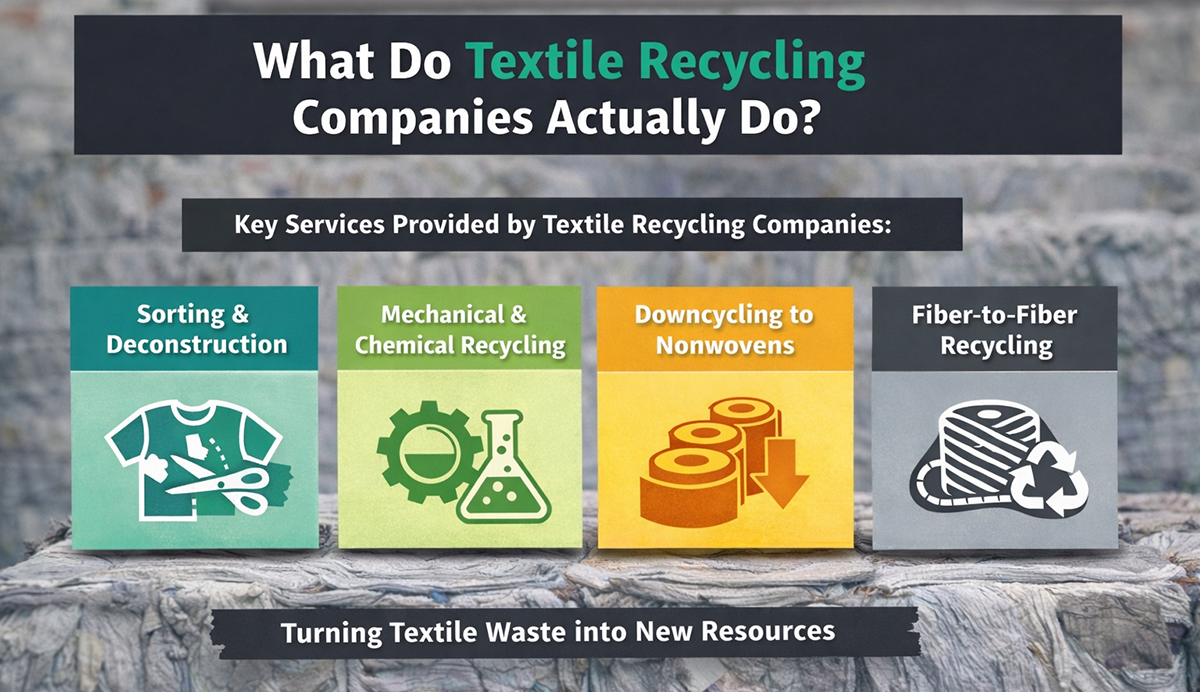
What Do Textile Recycling Companies Actually Do?

Textile recycling companies process pre- and post-consumer materials to keep them out of landfills and convert them into usable outputs. Depending on the provider, this may include:

However, not every company offers all of these services. As a result, brands must align their material type, volume, and goals with the right partner.

Textile vs. Fabric Recycling Companies: Is There a Difference?

The terms are often used interchangeably, but there are subtle differences:

  • Textile recycling companies typically handle full products, such as garments, uniforms, and mixed goods
  • Fabric recycling companies often focus more narrowly on production waste, including rolls, offcuts, and cuttings

In practice, brands benefit most from partners who can manage both—especially when dealing with mixed or complex waste streams. Looptworks processes both finished goods and production waste, enabling a more flexible and comprehensive approach to textile recycling.

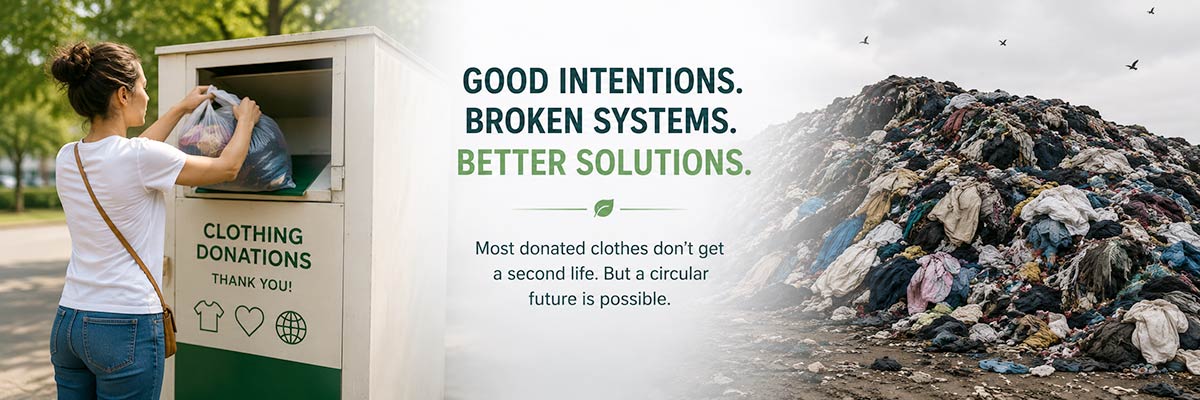
However, not all recycling pathways deliver the same environmental outcomes. Some collection programs and donation streams rely on exporting textiles overseas, where materials may ultimately be downcycled, incinerated, or landfilled. While these solutions can appear sustainable on the surface, they often shift the burden rather than solve it.

For brands, this creates both environmental and reputational risk. Working with partners that provide transparent processing, verified outcomes, and domestic recycling infrastructure helps ensure that textile waste is truly diverted—not just deferred.

What to Look for in a Textile Recycling Company

Choosing the right partner goes beyond location. Instead, brands should evaluate the following:

  1. Ability to Handle Mixed Materials. Most textile waste is not uniform. Blends, trims, and dyes add complexity. Therefore, look for partners that can process a wide range of materials.
  1. True Circular Outcomes. Some providers downcycle materials into lower-value uses. Others enable fiber-to-fiber recycling for new textile production. The difference matters.
  1. Scalability. Can the partner handle bulk volumes consistently? More importantly, can they grow with your program over time?
  1. Traceability and Certifications. Verified chain-of-custody is essential. Certifications such as GRS help ensure your sustainability claims are credible and audit-ready.
  1. Domestic Infrastructure. U.S.-based processing reduces logistics risk and improves transparency. It also supports faster implementation.

Why Brands Are Rethinking Textile Recycling

Historically, textile recycling options were limited. Many providers could not handle mixed materials or scale effectively.

Today, that is changing. As a result, brands are shifting toward solutions that:

  • Divert waste from landfill
  • Recover material value
  • Support ESG and compliance goals
  • Enable circular product development

In other words, textile recycling is no longer just a sustainability initiative—it is becoming a core operational strategy.

A New Standard for Textile Recycling Companies

A new category of textile recycling companies is emerging—one focused on scalable, fiber-to-fiber solutions.

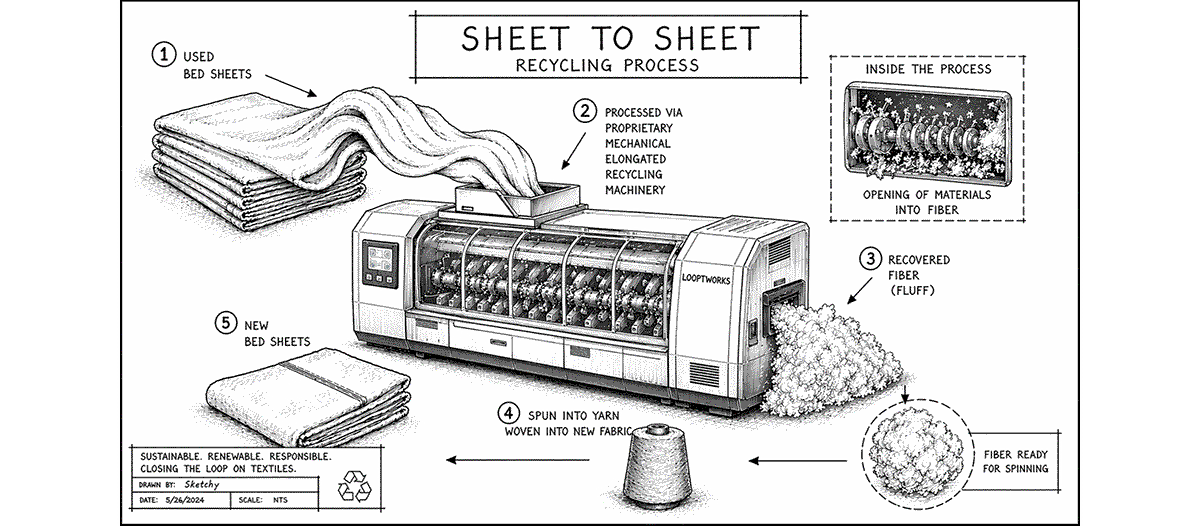
Looptworks operates at the forefront of this shift. With the ability to process multiple material types, including blends, Looptworks transforms excess textiles into high-quality recycled fiber. These fibers are suitable for new yarns and nonwoven applications.

As a result, brands can move beyond disposal and toward true circularity—without compromising on scale or performance.

From Excess Inventory to Circular Resource

The most effective textile recycling strategies do more than divert waste. They create new value streams. As infrastructure continues to evolve, brands have an opportunity to rethink excess inventory—not as a liability, but as a resource ready for its next lifecycle. That shift is already underway. The question is no longer whether to act, but how quickly brands can implement scalable solutions.

Have excess textiles to solve for?

Connect with Looptworks to explore scalable textile recycling solutions tailored to your materials, volumes, and goals.
Share the Post:

Related Posts

Denine Pezone Sales VP

Denine Pezone

Strategic Partnerships/Sales

Denine has over 20 years of experience driving new business opportunities for leading companies, including E.I. DuPont de Nemours & Company, Inc., The Dow Chemical Company, Outlast Technologies, and DST Systems. She holds a BS from the University of Pittsburgh and a Certification in Executive Management from the Kenan-Flagler School of Business at the University of North Carolina at Chapel Hill.

Headshot of Tami Bringman, Chief Financial Officer at Looptworks.

Tami Bringman

Chief Financial Officer

Tami is a senior accounting leader with over 16 years of experience in the manufacturing and textile industry. Her specialties include process development and implementation, mergers and acquisitions, job and project costing and analysis, and managing complex teams and technical projects. Tami has served as Chief Financial Officer and Controller for a variety of innovative companies, where her analytical skills and strategic mindset helped organizations create efficiencies in their financial systems.

Headshot of Kelley Purdy, Vice President of Partnerships at Looptworks.

Kelley Purdy

Vice President, Partnerships

Kelley is a passionate and strategically minded business development leader with more than two decades of experience in the sporting goods apparel industry. He has experience in product construction, league partnerships, retail relationships, supply chain management, sustainability, circularity, and carbon footprint management. Kelley builds successful partnerships by putting the customer first while simultaneously advancing his organization’s business objectives.

Suzy Off: Operations Director for Looptworks

Suzy Off

Chief Operating Officer

Suzy is a product leader and operations expert with more than 25 years of experience in the textile industry. She is passionate about finding creative solutions to complex problems and motivating people to action through vision, strategy, collaboration, and communication. Suzy has proven expertise in product development, sustainability, marketing, supply chains, and innovating processes and best practices to drive results.

Headshot of Scott Hamlin, Founder and CEO of Looptworks.

Scott Hamlin

Founder & CEO

Scott is a visionary leader with more than 32 years of experience in strategic branding, innovative product creation, supply chain sustainability, and sales and marketing for global organizations. He founded Looptworks in 2009 as an industry solution for turning excess materials into upcycled consumer products. In 2022, Scott transitioned the company to a B2B business model focused on eliminating global textile waste through closed-loop solutions.
Headshot of Scott Hamlin, Founder and CEO of Looptworks.

Scott Hamlin

Founder & CEO

Scott is a visionary leader with more than 32 years of experience in strategic branding, innovative product creation, supply chain sustainability, and sales and marketing for global organizations. He founded Looptworks in 2009 as an industry solution for turning excess materials into upcycled consumer products. In 2022, Scott transitioned the company to a B2B business model focused on eliminating global textile waste through closed-loop solutions.