
Upcycling, downcycling, and recycling are often used interchangeably. However, they describe very different approaches to managing textile waste.
Understanding these differences is essential. In fact, each method contributes to extending the life of materials. Yet, not all solutions scale equally.
At Looptworks, we began as a pioneer in upcycling. Since then, we have evolved. Today, we focus on textile-to-textile recycling because solving global textile waste requires scalable systems.
So, let’s break it down.
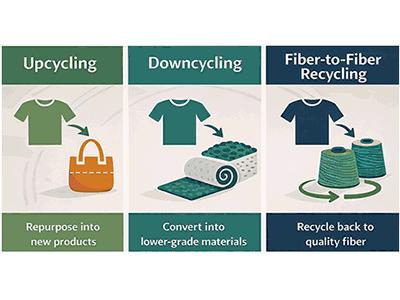
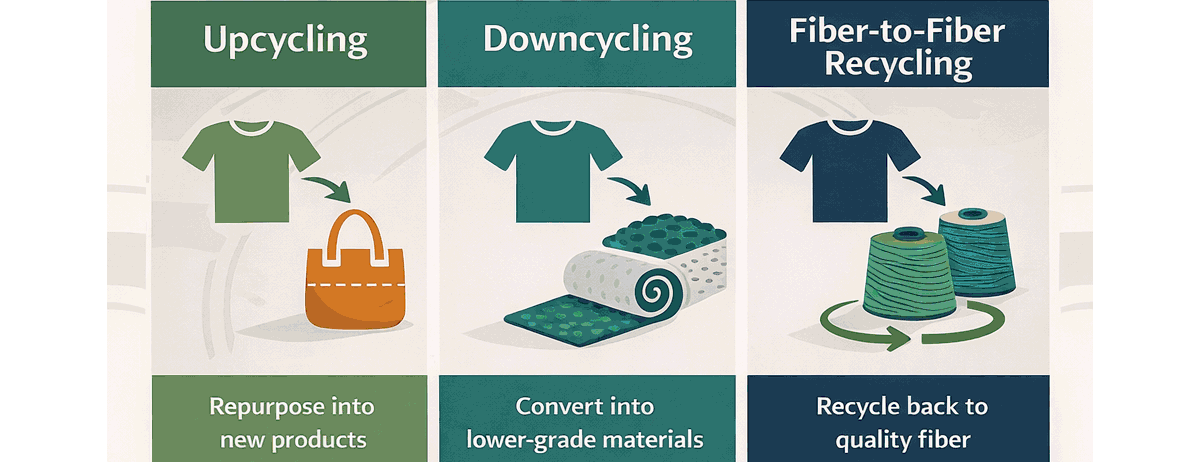
Upcycling transforms existing materials into new products without breaking them down into raw fibers. For example, a garment might be redesigned into a bag or accessory.
As a result, upcycling can extend product life and reduce waste in the short term. It also allows for creativity and storytelling, which many consumers value.
However, upcycling has limits. Because it relies on design and manual labor, it is difficult to scale. In addition, it typically handles small volumes of material.
Therefore, while upcycling is valuable, it cannot address the full of global textile waste.
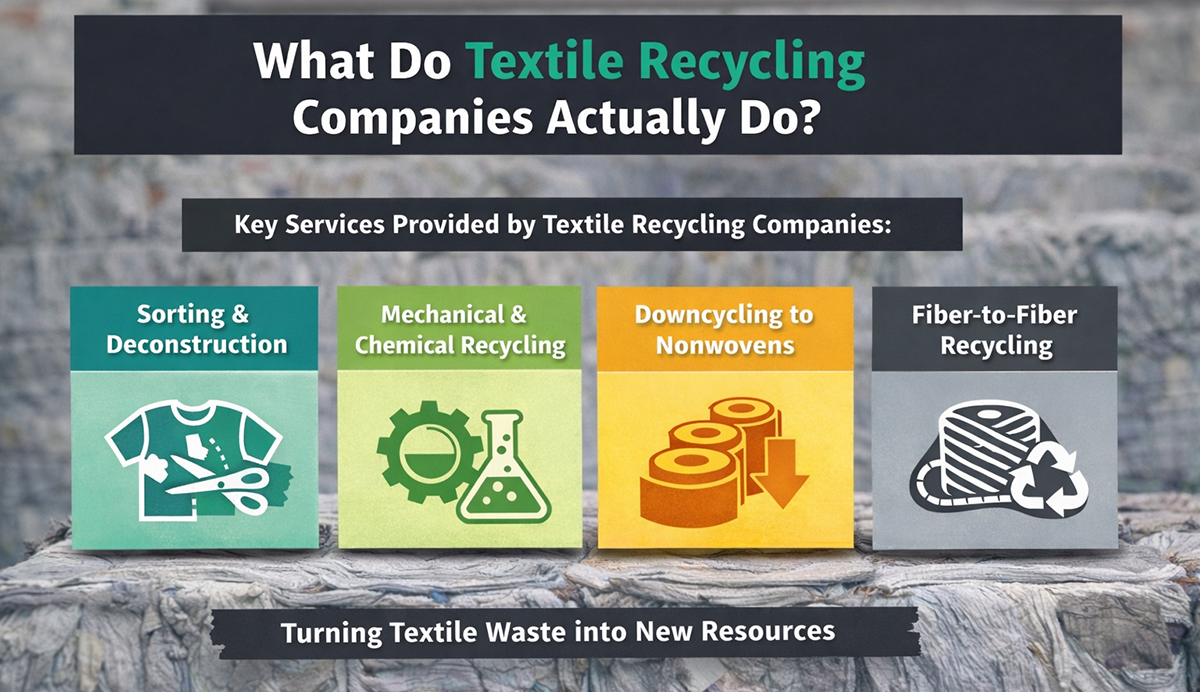
Downcycling converts textiles into lower-value materials. For instance, used garments may become insulation, carpet padding, or industrial fillers.
This approach is more scalable than upcycling. It can process larger volumes and support a range of industrial applications.
However, downcycling reduces material quality. As a result, fibers often cannot be reused again. In many cases, this is the final step before landfill.
Even so, downcycling still plays an important role. It helps divert waste and supports nonwoven markets.
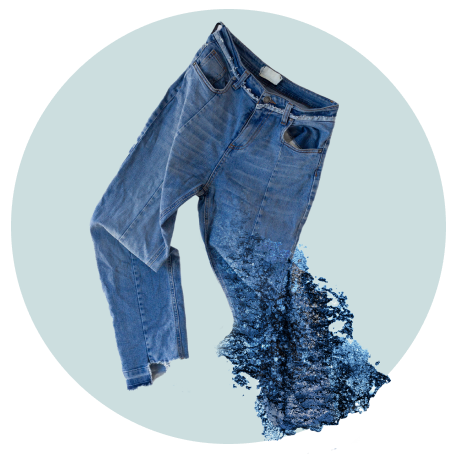
Recycling, specifically textile-to-textile recycling, returns textiles to fiber form. These fibers can then be spun into new yarns or used in high-value applications.
Unlike downcycling, this process aims to preserve material value. In addition, it supports true circularity by keeping fibers in continuous use.
At Looptworks, we use mechanical recycling systems to process both pre- and post-consumer textiles. This includes a wide range of materials, from cotton to blends.
As a result, we can produce high-quality recycled fiber at scale. This makes textile-to-textile recycling a critical solution for the industry’s future.
Upcycling is an important step. However, it cannot solve the larger problem on its own.
First, the volume of global textile waste is massive. Millions of tons are generated each year. Small-batch solutions cannot keep up with that scale.
Second, upcycling depends on labor and design. This limits consistency and throughput.
Finally, many textiles are not suitable for upcycling. Damaged, mixed, or low-quality materials still need a solution.
For these reasons, scalable recycling infrastructure is essential.
The industry is evolving. Increasingly, brands and organizations are looking for solutions that go beyond reuse.
As a result, textile-to-textile recycling is gaining momentum. It offers a way to process large volumes while maintaining material value.
In addition, regulatory pressure is increasing. Policies like extended producer responsibility (EPR) are pushing brands to take responsibility for their waste.
Therefore, investing in scalable recycling systems is no longer optional. It is becoming a business requirement.
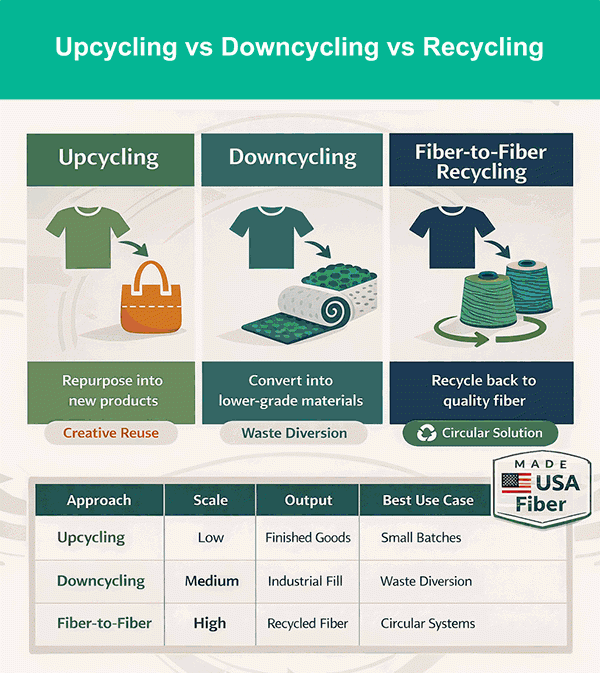
Each approach serves a purpose. However, they deliver different outcomes.
In other words, the future depends on solutions that can handle both complexity and volume.
At Looptworks, our journey reflects the evolution of the industry.
We started with upcycling. Over time, we saw its limitations. As demand for scalable solutions grew, we adapted.
Today, we focus on processing excess textiles into high-quality recycled fiber. This supports both yarn production and nonwoven applications.
Most importantly, our system is designed for scale. It helps brands move closer to zero waste to landfill while maintaining supply chain value.
No single solution can solve textile waste alone. However, together, these approaches create a pathway forward.
Upcycling extends product life. Downcycling diverts waste. Recycling closes the loop.
Now, the opportunity is clear. By investing in fiber-to-fiber recycling, the industry can move toward true circularity.
Explore how Looptworks can help you turn pre- and post-consumer materials into high-quality recycled fiber—while keeping textiles out of landfill.
Reach out to us today!

Denine has over 20 years of experience driving new business opportunities for leading companies, including E.I. DuPont de Nemours & Company, Inc., The Dow Chemical Company, Outlast Technologies, and DST Systems. She holds a BS from the University of Pittsburgh and a Certification in Executive Management from the Kenan-Flagler School of Business at the University of North Carolina at Chapel Hill.

Tami is a senior accounting leader with over 16 years of experience in the manufacturing and textile industry. Her specialties include process development and implementation, mergers and acquisitions, job and project costing and analysis, and managing complex teams and technical projects. Tami has served as Chief Financial Officer and Controller for a variety of innovative companies, where her analytical skills and strategic mindset helped organizations create efficiencies in their financial systems.

Kelley is a passionate and strategically minded business development leader with more than two decades of experience in the sporting goods apparel industry. He has experience in product construction, league partnerships, retail relationships, supply chain management, sustainability, circularity, and carbon footprint management. Kelley builds successful partnerships by putting the customer first while simultaneously advancing his organization’s business objectives.

Suzy is a product leader and operations expert with more than 25 years of experience in the textile industry. She is passionate about finding creative solutions to complex problems and motivating people to action through vision, strategy, collaboration, and communication. Suzy has proven expertise in product development, sustainability, marketing, supply chains, and innovating processes and best practices to drive results.
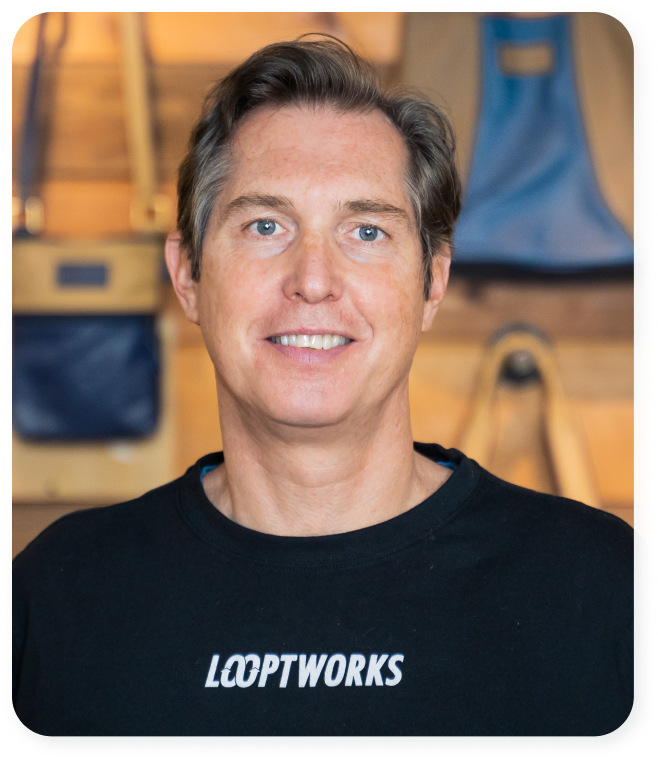
Scott is a visionary leader with more than 32 years of experience in strategic branding, innovative product creation, supply chain sustainability, and sales and marketing for global organizations. He founded Looptworks in 2009 as an industry solution for turning excess materials into upcycled consumer products. In 2022, Scott transitioned the company to a B2B business model focused on eliminating global textile waste through closed-loop solutions.
Scott is a visionary leader with more than 32 years of experience in strategic branding, innovative product creation, supply chain sustainability, and sales and marketing for global organizations. He founded Looptworks in 2009 as an industry solution for turning excess materials into upcycled consumer products. In 2022, Scott transitioned the company to a B2B business model focused on eliminating global textile waste through closed-loop solutions.