
Since our founding, Looptworks has been driven by a singular goal: to reduce the staggering amount of waste generated by the textile industry. What started as a mission rooted in upcycling has since evolved into something much greater. Today, we are proud to be a full-scale textile recycling company focused on advancing circularity—a regenerative system in which textile materials are used, recovered, and reused in a closed loop, minimizing environmental impact.
To understand how we approach waste, it’s important to break down the different methods of giving used textiles a second (or third!) life.
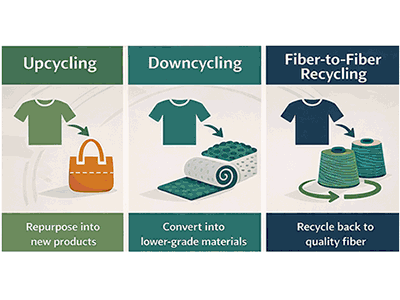
Downcycling involves breaking down used textiles and converting them into new products of lower quality or reduced functionality compared to their original state. For example, old cotton T-shirts might be shredded into rags, carpet padding, or insulation. While the original fabric structure is lost, the material itself avoids ending up in a landfill—extending its lifecycle in a less demanding application.
In the world of textiles, downcycling is still incredibly valuable. It diverts tons of fabric from waste streams and provides raw materials for other industries. At Looptworks, we offer downcycling services for materials that can’t be reused or remade but still have functional value.
Upcycling is where the Looptworks story began. Unlike downcycling, upcycling keeps the original material largely intact and transforms it into a product of higher value. For instance, we’ve turned excess airline leather into durable, one-of-a-kind bags and accessories. These pieces are not only functional—they’re beautiful, limited-edition items that tell a story.
Textile upcycling emphasizes design, craftsmanship, and creativity, preserving the embedded energy, labor, and water already used to create the original fabric. It’s a way to celebrate the uniqueness of each material while actively reducing the need for virgin textile production.
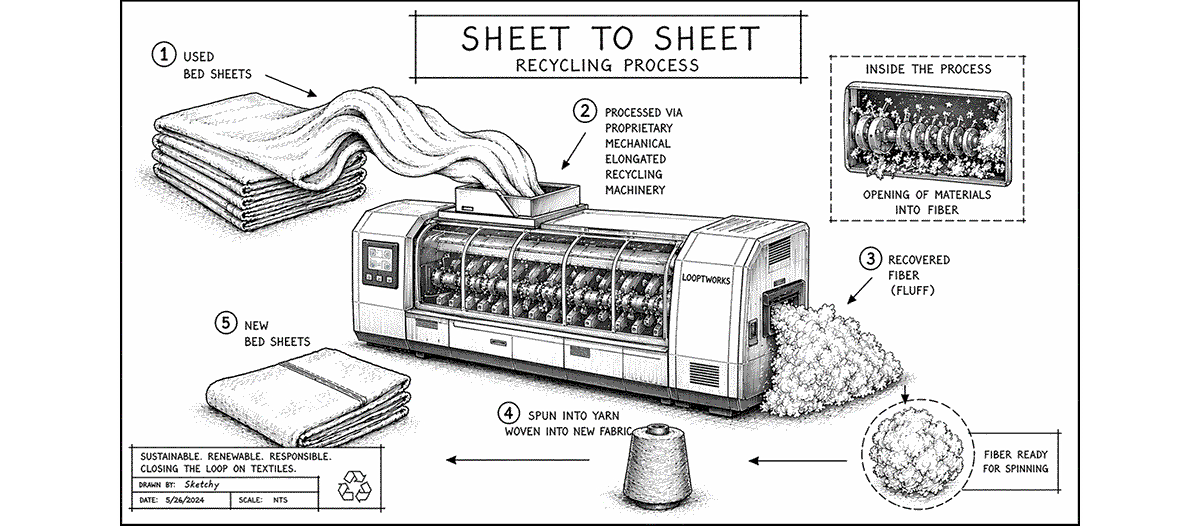
Recycling in textiles encompasses both upcycling and downcycling, but it also includes fiber-to-fiber recycling—a process that breaks materials down to their fundamental fibers and re-engineers them into new textiles. This method represents the cutting edge of circularity, and it’s where Looptworks is currently focusing much of our innovation.
Unlike mechanical recycling, which can weaken fibers over time, advanced fiber-to-fiber techniques allow materials like cotton or polyester to be deconstructed and remade with little loss in quality. The result? High-performance, recycled fabrics that can be used again and again, truly closing the loop.
With our new facility in Gresham, Oregon—the first of its kind on the West Coast—we now offer both downcycling and fiber-to-fiber textile recycling at scale. This milestone has transformed Looptworks from a pioneering upcycler into a comprehensive textile recycling company, one that’s pushing the industry toward a circular economy.
We partner with businesses, brands, and institutions to responsibly recover textile waste and give it new life. Our goal is to eliminate textile waste entirely, ensuring that materials stay in use and out of landfills.
Together with our partners and community, we’ve achieved:
Every piece of fabric we rescue contributes to a larger movement toward sustainability.
Looking forward, we aim to scale our impact by expanding our recycling capabilities, fostering partnerships, and continuing to innovate. The future of fashion and textiles must be circular—and we’re proud to be at the forefront of that transformation.
Join us in creating a closed-loop system where no textile is wasted. Learn more about our recycling solutions and how to partner with us at looptworks.com/circular-solutions.
Scott is a visionary leader with more than 32 years of experience in strategic branding, innovative product creation, supply chain sustainability, and sales and marketing for global organizations. He founded Looptworks in 2009 as an industry solution for turning excess materials into upcycled consumer products. In 2022, Scott transitioned the company to a B2B business model focused on eliminating global textile waste through closed-loop solutions.
Scott is a visionary leader with more than 32 years of experience in strategic branding, innovative product creation, supply chain sustainability, and sales and marketing for global organizations. He founded Looptworks in 2009 as an industry solution for turning excess materials into upcycled consumer products. In 2022, Scott transitioned the company to a B2B business model focused on eliminating global textile waste through closed-loop solutions.